Spanish Version

Showing posts with label Cathedral of Tui. Show all posts

2015/08/23

The Portuguese Way of Saint James in Tui. Monuments of its Historical Site. Part 1.


We return to Tui, on the banks of the River Miño to the south of the province of Pontevedra. Tui is the entry point of the Portuguese Way of Saint James in Galicia and has important monuments that bear witness to its history.

As is known the Cathedral of Santa María is the most representative monument in Tui. Click here to see our previous visit to the Cathedral of Tui.

We begin the walk right next to the Cathedral in the Capilla de la Misericordia (Chapel of Mercy). Beside it the hostel for pilgrims is located. The Chapel of San Telmo is a few metres down the street. We will retrace our steps to see the Convent of the Poor Clares (or Encerradas).

After going through the tunnel underneath the convent we will go towards the remains of the medieval wall in Porta da Pía and Ordóñez Street. Then we will approach the Church of San Francisco to finish our walk at the Convent of Santo Domingo.


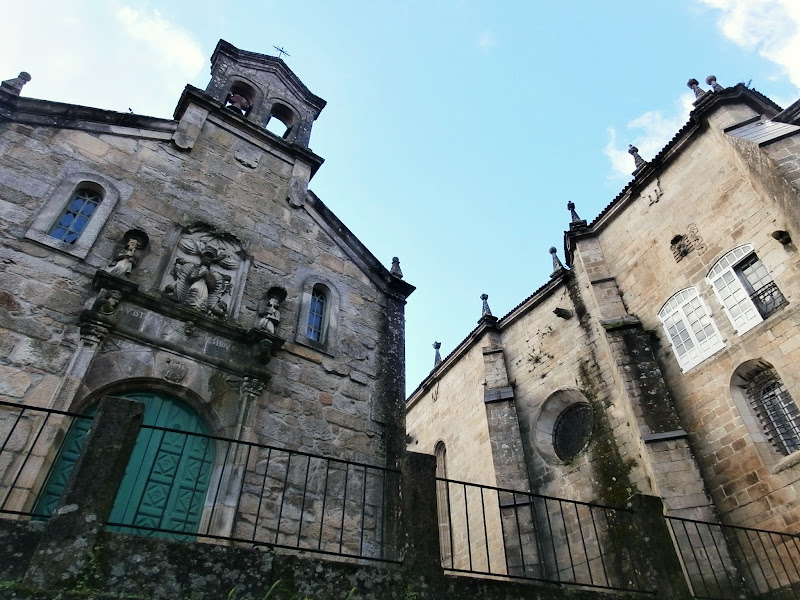
Our starting point: The Capilla de la Misericordia. It is located beside the east façade of the Cathedral (to the right of the picture).


Coordinates to find the location of Tui in Galicia. Extend the map and reach the Capilla de la Misericordia: 42.046196, -8.643919


2015/05/20

2015/05/16

Cathedral of Tui. The Inside. Part 5. The Cloister (II).


This is the second part of our visit to the Cloister of the Cathedral. We will see the east gallery and the Romanesque Chapter House and also the viewpoint and the gardens of the palace.


2015/05/14

Cathedral of Tui. The Inside. Part 5. The Cloister (I).


The Gothic Cloister was built in the first half of the 13th century. The south gallery of the cloister was rebuilt in the 15th century incorporating several burials. The Tower of Soutomaior was also built in the 15th century in the southwest corner of the cloister.

Besides the mentioned graves the cloister (all of its galleries and the Romanesque chapter house that is located in the east gallery) is part of the Cathedral Museum. The other part of the Museum is the Chapel of Santa Catalina which houses the Cathedral Treasure.


2015/05/11

Cathedral of Tui. The Inside. Part 4. Cathedral Museum. Chapel of Santa Catalina (II).


Our visit to the Museum continues.


We can see in the center of the picture in its lower part the reliquary Copón de Coco. It is made of silver and coconut (15th century). There are also chalices of different historical periods.


Cathedral of Tui. The Inside. Part 4. Cathedral Museum. Chapel of Santa Catalina (I).


The Cathedral Museum is divided into three parts: the Chapel of Santa Catalina, the Cloister and the Chapter House.

The Chapel of Santa Catalina:

It is located beside the right aisle of the Cathedral. It is Gothic (14th century) but it was entirely transformed in the 17th and 18th centuries. The Cathedral Treasure is guarded in the Chapel of Santa Catalina.

The reliquary called Copón de Coco, the statue of the Virgin and Child “la Patrona”, the complete red three-piece suit (16th century), the silver amphorae of the Holy Oils, Processional Monstrance (1602), the statue of Saint Anne, Madonna and Child (1520), the Ship of San Telmo, Baroque altarpieces stand out among the valuable treasures that the Cathedral Museum contains.


2015/05/08

Cathedral of Tui. The Inside. Part 3. The Chapels of the Church.


We will visit today the chapels of the Cathedral. They are: the Chapel del Santísimo that is located beside the aisle to the left. The High Chapel in the apse has the Chapel of Santiago and the Chapel of San Pedro on both sides. We will also see the Chapel of San Telmo also called Chapel of the Relics. The Chapel of Santa Catalina deserves separate treatment by being there the Cathedral Museum.


2015/05/05

Cathedral of Tui. The Inside. Part 2. The Transept of the Church.


The transept is of Romanesque style. It has three naves. Part of the transept is an extension of the side aisles being similar to the Cathedral of Santiago de Compostela. Both are pilgrimage churches.


The central nave of the transept in its northern part is occupied by the Monumento de Semana Santa (Holly Week Monument). The altarpiece de la Expectación is in the southern part.

The Chapel of Santo Cristo de la Agonía (northern part) and the Chapel Altarpiece of la Soledad (southern part) are located in the aisles of the transept. Romanesque capitals that are located in the transept stand out for their rich ornamentation.


2015/05/02

Cathedral of Tui. The Inside. Part 1. The Naves of the Church.


We start here the visit to the Cathedral. We will divide the visit into parts. First we will see the Church, after the Cathedral Museum and last but not least the Cloister.

As regards the Church we will see first the naves, after the transept and last the chapels of the Cathedral (Chapel del Santísimo, Chapel of Santiago, the Main Chapel, Chapel of San Pedro and Chapel of San Telmo).

The Cathedral Museum follows the chapels because the Museum is located in one of them, Chapel of Santa Catalina.

The Cloister also contains important archaeological remains which belong to the Museum. We also will see the Romanesque Chapter Hall and the Tower of Soutomaior.


Today we will see the naves of the Cathedral.


2015/04/28

Cathedral of Tui. The Arrival.


Welcome to the Cathedral of Tui.

Tui is a municipality which has a population of approximately 17000 inhabitants. It is located south of the Province of Pontevedra beside the River Miño which separates Spain from neighboring Portugal (click here to see Tui in Google Maps).

The Cathedral of Santa María is located in the highest part of the town and it has shaped its appearance as a defensive fortress due to Tui status as a border town in the past. The Cathedral is an important crossing point on the Portuguese Way of Saint James.